

When selecting glass in a bathroom, it may seem like a simple decision, but there are many factors to consider. Each of the above items can influence the performance of the glass partition over time. Make a mistake, and you will have a leak, rusted hardware or an unstable glass panel. Decisions are even more critical in Kolkata’s climate, where the monsoon humidity and moisture throughout the year exert persistent pressure on bathroom installations. This guide lays out all of the considerations you must understand before deciding on a bathroom glass partition.
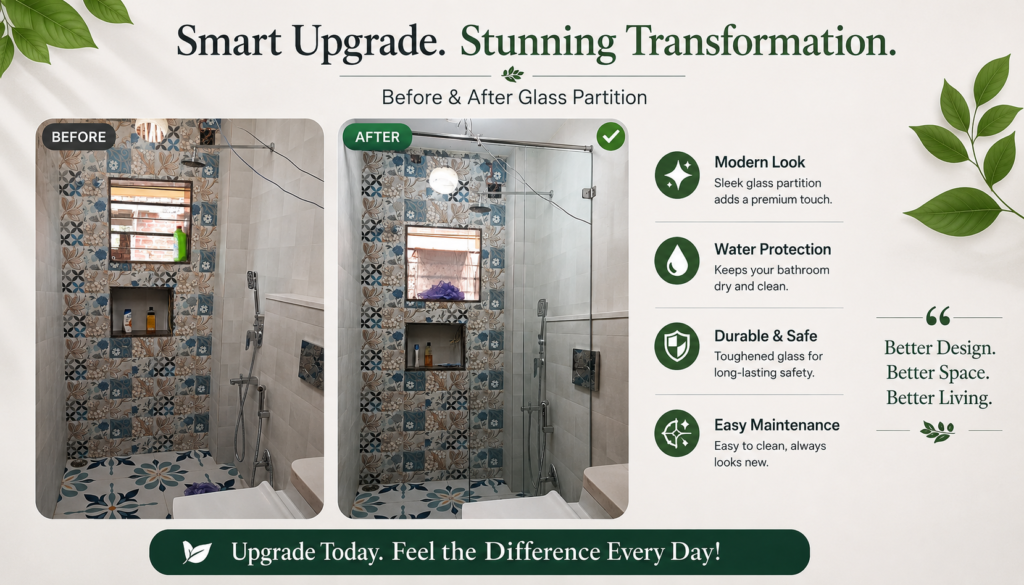
Table of Contents
Why are Bathroom Glass Partitions Replacing Traditional Walls in Kolkata Homes?
The bathrooms of Kolkata homes have undergone a remarkable change in the last decade. What once was a purely functional space is now part of the overall interior design. With that change, the materials and methods used to separate wet and dry areas inside the bathroom have also changed.
Frameless Glass Partitions Replace Curtains and Tiles in Urban Bathrooms
The traditional way of separating the wet zone and the dry zone in a bathroom has been quite easy: a shower curtain or a low tile wall, or at most, a framed wall. These solutions were effective, but they had regular issues. Mould can easily be trapped in curtains in moist environments. Low walls of tiles are not effective in holding water together. Framed metal enclosures rust in a few years, especially in cities like Kolkata, where the humidity in the bathroom remains high for the majority of the year.
Frameless glass partitions solve these problems directly. A single panel of toughened safety glass, sealed properly at the floor and wall, contains water without trapping moisture. There are no metal frames to rust, no fabric to develop mildew, and no grout lines inside the enclosure to discolour over time. That is why residential glass partition installations in Kolkata have grown steadily — not because of aesthetics alone, but because frameless glass simply performs better in wet area conditions over the long term.
Frameless glass partitions solve these problems directly. A single panel of toughened safety glass, perfectly sealed at the floor and wall, holds water but not moisture. No metal frames to rust, no fabric to suffer from mildew and no grout lines in the enclosure to fade with time. This is to understand why the installation of residential glass partitions in Kolkata has been steadily increasing, not just because of the looks, but because frameless glass partitions simply perform better in wet-area conditions over the long term.
Glass Partitions for the Bathroom
Bathroom Glass partitions Design Today: What Modern Kolkata Homeowners Expect.
There have been two changes in the requirements of the bathroom partition: the function and the appearance. From a functional point of view, homeowners have come to expect the partition to maintain their dry area and limit maintenance and last for years of daily use without hardware failure. The trend in design has shifted to modern interiors that dominate urban apartments in Kolkata
Types of Glass Partitions Used in Bathrooms
It is important to know what options you have when choosing a glass partition for your bathroom. There is more to the differences between the types than just appearances: differences in privacy, maintenance, space perception and partition use in daily life.
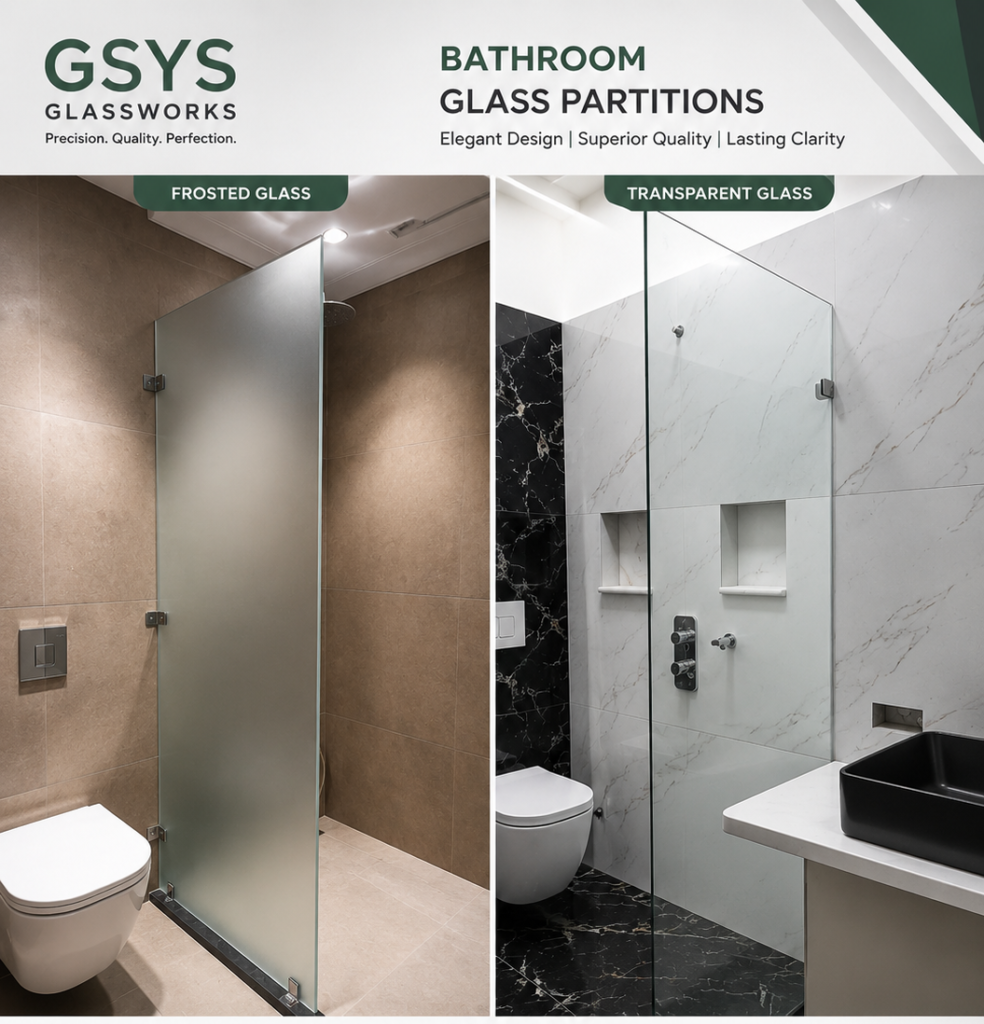
Frosted glass partitions offer privacy without blocking the light.
Frosted glass is made by acid-etching (or sand blasting) one side of a toughened glass panel. The result is a translucent but not opaque coating which diffuses light while obscuring direct visibility through the glass. This makes it the perfect choice for bathrooms where privacy is the primary concern.
The panel still allows the natural light to pass through, which is important in bathrooms that may have limited ventilation or window space. Watermarks and soap residue are not as visible on a frosted surface as they are on clear glass, meaning you don’t have to wipe the panel down as often.
Transparent Glass Partitions — Open, Spacious Feel for Larger Bathrooms
Transparent glass partitions are made with clear toughened safety glass, providing a clear view through the panel. The biggest advantage of transparent glass is its ability to perceive space. A clear glass panel is the best choice for medium to large bathrooms, as it makes the space appear larger and more open than anything else in the way of opaque.
On clear glass panels, water spots, limescale deposits and soap marks are readily visible and require regular wiping to keep the panel bright and clean. Kolkata experiences water hardness based on geographical location and the source of water, so a clear glass with limescale can be a problem now and then without an anti-limescale glass coating or consistent cleaning.
Single-Panel Fixed Partition or Shower Enclosure
These are the two most popular choices for bathroom glass partitions, and they have different functions.
A single-panel fixed partition with no swinging parts is defined as a fixed partition. It provides a physical barrier between the wet and dry zones, without completely enclosing the shower area. One side of the showering space is open for entry. Ideal for bathrooms where space is limited or for shower areas with less space. There are no hinges, so maintenance is easy and hardware failure is not an issue.
A shower enclosure has a swinging glass door and a partition setup, fully enclosing the shower area on all sides. This keeps water containment more complete and gives the shower zone a defined, enclosed feel. The door is typically mounted on SS hinges with a soft-close mechanism, and the enclosure may use two or three glass panels depending on the bathroom layout.
The practical difference comes down to space and water containment. Usually, a single fixed panel is more sensible in a bathroom — movement problems with a swinging door in a tight space. In larger bathrooms, where a complete enclosure is desired, a frameless glass enclosure with a hinged door offers superior water separation and a more finished look. The quality of fittings is especially important in a shower enclosure since they are exposed to daily mechanical stresses such as hinge grade, wall clamp quality and floor seal.
Only Toughened Safety Glass Should Be Used in Wet Areas
This is not an option; it is a safe one. The regular glass, if broken, fragments into large, sharp pieces, causing them to cause serious injuries. The consequences of using a standard glass can be serious when the surface is wet and slippery and someone might fall against the glass wall, as in a bathroom.
Toughened safety glass is processed through a controlled thermal heating and rapid cooling cycle that changes its internal stress structure. When toughened glass breaks, it fragments into small, blunt pieces rather than sharp shards, which significantly reduces the risk of injury.
In addition to safety, toughened glass is also much stronger than standard glass of the same thickness. It handles thermal stress better, which is relevant in bathrooms where hot shower steam meets cooler ambient air regularly, and resists the mechanical stress of daily use, cleaning, and hardware contact more effectively.
Always ensure that the glass being provided for a bathroom glass partition in Kolkata is certified toughened safety glass when taking quotes for glass partitions. There are some suppliers who use the term ‘toughened’ in a loose way. The only sure way of verification is the certificate.
Glass Thickness: The glass thickness should be based on the specific application
When it comes to bathroom partition planning, one of the biggest misconceptions is about the thickness of glass. Homeowners either do what the supplier tells them to do without knowing why, or they go for the thicker option, thinking more is better. The thickness is not based on a general preference for thicker glass, but rather on a variety of factors, including panel size, installation format and how the glass is supported.
For most standard bathroom glass partitions in Kolkata, 10mm toughened safety glass is sufficient. It offers the structural strength necessary for a fixed single panel; it withstands daily cleaning and contact without flexing; and it performs reliably when the panel dimensions are within a moderate range — typically up to about 900 mm wide and 2000 mm high.
10mm glass is the recommended thickness for wider or taller panels, panels with a hinged door, or those installations with limited support for the glass on one or more sides. Every time a hinged glass door is opened and closed, it is subjected to mechanical stress – 10 mm glass handles this stress better over the years.
The choice of thickness depends on the size and width of the bathroom.
The connection between the unsupported span of the glass panel and the thickness of the glass is very simple; the thicker the glass is, the more rigid it is and the less it deflects when it is under its own weight or when it is placed under contact pressure.
A narrow panel (600mm to 750mm) attached firmly to a wall on one side and secured to the floor with a channel is effective in carrying a load of 8 mm. The short span is unsupported, so there is no need to make the glass thicker to keep it rigid. For the compact bathroom in Kolkata, where the space for the shower area is limited and the partition panel is relatively small, 8mm is the practical and economical option.
A wider panel (900mm to 1200mm or more) has a longer unspanned length between fixing points. With this width, 8mm glass is able to bend slightly under lateral pressure, causing stress on the silicone seals and hardware connections over time. In 10 mm, that flex will be removed, and the installation will be more stable for the long term.
The same applies to the height of the panels. If the partition is to be full height (2400 mm or more), it will require more thickness than one stopping at 1800 mm to 2000 mm, especially if the top of the partition is not supported. Before deciding on the thickness, always check the dimensions of the panels with your glass contractor, as it is directly related to the panel’s size.
Fittings and Hardware — The importance of fittings and hardware.
Most homeowners consider the type of glass, its thickness, and the cost of the glass partition when selecting one, but they fail to consider the hardware that holds the entire partition together. Poor-quality fittings can cause the failure of the best-quality glass. Lower-quality hardware will rust more easily, loosen, and compromise the stability of the glass in the long run.
Why are SS 304 Grade Fittings the minimum requirement in a bathroom
SS stands for stainless steel, and not all stainless steel performs the same way in a wet environment. The grade of stainless steel determines its corrosion resistance, and in a bathroom — where hardware is exposed to water, soap, cleaning chemicals, and humidity every single day — grade matters significantly.
SS 304 is an austenitic stainless steel alloy containing chromium and nickel in proportions that give it reliable corrosion resistance in standard indoor wet conditions. For residential bathroom glass partitions in Kolkata, SS 304 grade fittings represent the minimum acceptable standard. Below this — mild steel with a chrome coating, zinc alloy fittings, or ungraded stainless steel — the hardware will begin to show rust and surface degradation within one to three years of installation in a regularly used bathroom.
SS 304 fittings ensure long-lasting durability of bathroom fittings in Kolkata. In corrosive environments such as coastal seawater or highly salted environments, SS316 stainless steel provides even better corrosion resistance. Always check the type of stainless steel hardware used; lower quotations may be the price of using lower quality fittings and not real stainless steel hardware.
When getting a quote, ask the contractor specifically which grade of SS fittings is included. A significant price difference between two quotes for the same glass specification is often explained by the hardware grade — one contractor is using SS 304 and another is using cheaper ungraded fittings that look identical but perform very differently over time.
The size and design of the glass partition in your bathroom can influence your choice.
The size and layout of a bathroom can play a significant role in determining which type of glass partition is suitable and which is not. A large master bathroom that is nicely partitioned can make a small bathroom feel cramped, awkward and difficult to use. Avoiding the time and cost of poor planning and installation decisions that result from not understanding how size and layout influence this decision.
Glass Partition Options for Small Bathrooms
In a small bathroom, floor space is limited, movement inside the space is restricted, and a single-panel fixed glass partition is almost always the right choice. It separates the wet area from the dry area and allows for simple and structurally minimal installation. A frosted glass panel has two functions. It provides privacy, and it keeps the bathroom open, not splitting it up.
A bathroom hinged-door enclosure is not a good idea. A small bathroom will not have enough clearance for the door swing without it hitting the toilet, vanity or other wall. A sliding glass door (that glides parallel to the glass instead of swinging outward) is a space-saving option that you can consider if full enclosure is truly necessary in a small bathroom and may be a good alternative to discuss with your contractor.
In a small bathroom, the dimensions of the panel are also restricted, and so 8mm toughened safety glass is usually adequate. The shorter unsupported spans that are involved are not going to require any extra thickness, and the use of 8mm glass will ensure that there is no unnecessary visual weight within a space that should feel as light and open as possible.
Cost Factors for Bathroom Glass Partitions in Kolkata
The factors that influence the price of a bathroom glass partition enable homeowners to get a better idea of how much a quote will cost and to not make a decision based on price alone. The cost of a partition installation isn’t simply the price of the glass; it is the sum of a number of different elements, all of which can impact the initial price tag and the overall value of the installation.
What Influences the Price — Glass Type, Thickness, Fittings, and Size
Four factors are responsible for the price variations in bathroom glass partition quotes in Kolkata.
Glass type: The first variable is the type of glass. Frosted glass is slightly more expensive than clear glass of the same thickness, as it is subjected to an additional process of acid-etching or sandblasting. Textured glass options are priced similarly to frosted, or slightly more, depending on the pattern and availability. The difference between glass types, at the same thickness, is not dramatic, but it is a consistent factor across suppliers.
Glass thickness: The thickness of the glass is more important in determining the cost. The thickness of the safety glass is noticeable when moving from 8 mm to 10 mm toughened safety glass. Thickness also influences hardware costs, as thicker glass also needs heavier-rated hardware and sometimes requires extra wall fixing points to support the extra weight. The price difference between 8 mm and 10 mm isn’t simply the glass; it’s the entire hardware package.
Fittings and hardware grade: The most significant variations in quotes are usually in the fittings and hardware grade. The differences between two quotations for the same glass specification can be 20% to 40% depending on whether one is using SS 304 grade fittings, ungraded fittings, or zinc-alloy fittings. The hardware is less visible in a breakdown of a quote, as suppliers don’t break out the fitting grade in detail, so it is important to ask specifically for this grade before taking any quote.
Panel size: The cost of panels is directly related to the size of the panel, with larger panels costing more glass, silicone and installation time. A full-height partition (floor to ceiling) is more expensive than a partition which ends at 2000mm. A larger panel will be more expensive than a smaller panel. Multiple panel corner enclosures with a hinged door are more expensive than a straight single panel enclosure. In any quote, size is the most obvious cost driver.
Conclusion
Making the Right Choice for Your Bathroom: There are just a handful of right decisions to make at the outset of picking the right bathroom glass partition. Consider the type of glass for privacy requirements and bathroom layout. That applies to all installations, whether it is on a low budget or budget-friendly, ensuring the glass is toughened safety glass. Use standard hardware to a minimum of SS 304. Make sure that the quote is for a floor channel which is properly installed and has silicone sealing at all connections. Then select the thickness of the glass according to the size of the panel, and not on assumption. The latter are not hard to meet, but they are the ones that distinguish a partition that will run reliably for years from one that will start to fail in the first few years.
FAQ Section
Q1. Which glass is safe to use for bathroom partitions in India?
Bathroom partitions should be made of toughened safety glass as per IS 14900 only. Toughened glass is far safer in a wet bathroom environment where the risk of slips and impact is greater, as it breaks into small, blunt fragments rather than the sharp shards that ordinary glass would produce.
Q2. What is the ideal thickness of glass for bathroom partitions?
In most cases, 10 mm toughened glass will suffice for standard bathroom partitions. If the panel is wider than 900mm or has a hinged door, go to 10 mm. 12mm is for large panels or fancy installs. Don’t make the thickness based on personal preference; base it on panel width and height.
Q3. Which is better for bathroom partitions, frosted or clear glass?
Frosted glass is ideal for small bathrooms and spaces where privacy is a must. For larger bathrooms where you want the open, spacious feel and you care less about privacy, clear glass is best. What works best for you depends on the layout of your bathroom and how you use it on a day-to-day basis.
Q4. Why do bathroom glass partition fittings rust if they are stainless steel?
Not all stainless steels perform equally well in wet conditions. Below SS 304 grade fittings, including chrome-coated mild steel or ungraded alloys, lack sufficient corrosion resistance for everyday bathroom humidity. Always check the minimum grade of SS 304 before you finalise any bathroom glass partition contractor.
Q5. What should be included in a quote for a bathroom glass partition?
A complete quotation should encompass the glass panel, SS grade fittings, installation of floor channel and silicone sealing at floor and wall joints. If any of these are not included in the scope of work, then the price quoted does not represent a complete and watertight installation.